5 Common Dust Collection Mistakes Manufacturers Make & How to Fix Them
Before we dive into the mistakes, if you’re new to dust collection or need a refresher on how these systems work, read our complete guide to industrial dust collection systems first.
If your operation generates heavy chips, shavings, or high-volume bulk material and you’re burning through filters, you may need a cyclone dust collector instead. Read our guide to industrial cyclone dust collectors to see if that’s the right fit for your operation.
At Collectors & Filters, we’ve been designing, installing, and servicing dust collection systems since 1955. Over those decades, we’ve walked through hundreds of Indiana facilities and watched the same mistakes repeat themselves.
Here are the five most common dust collection mistakes we see and how to fix them before they cost you.
Mistake #1: Un-Engineered Modifications to Your System
What we see: A facility installs a properly engineered dust collection system. Then, over time, they add new equipment, another CNC router, an additional sanding station, a new production line. Someone adds more ductwork, branches, and hoods without recalculating the impact on the system.
Why it’s a problem: Diane Cave, an explosion protection specialist with over 15 years of experience, explains that when you add branches without accounting for static pressure and airflow requirements, you starve the hoods. The air isn’t moving fast enough to capture dust, so it escapes into your facility. The system still sounds like it’s running, but it’s not doing its job.
A cabinet shop called us because fine dust was escaping from their CNC area. When we walked in, we found out they added three branches to their original system. The static pressure had doubled, and their primary pickup points were barely pulling air.
Our fix: Before you add any equipment, recalculate your system’s static pressure and airflow requirements. If you’ve already made modifications, call us for a professional assessment. We’ll measure actual airflow at every hood and tell you what needs to change.
Mistake #2: Undersizing the Fan
What we see: Facilities choose a fan based on theoretical calculations for clean, new filters. They don’t account for the reality that filters get dirty, systems wear down, and production sometimes increases.
Why it’s a problem: When fans are undersized, they lose flow over time. Dust starts settling in the ductwork which creates a fire hazard and eventually blocks the system entirely. Diane Cave again notes that when she sizes systems, she allows for 4 to 6 inches of pressure loss across a dust collector for dirty filters. If your fan can’t handle that, you’re in trouble.
The fix: Size your fan with real-world dirty-filter conditions in mind, not just clean/new specs. A properly engineered fan should handle 4–6 inches of water column (in. w.c.) additional static pressure drop as filters load up, this is the margin most systems need to maintain consistent airflow and transport velocity over time. Schedule filter changes or pulse cleaning based on rising differential pressure (e.g., change at 5–6 in. w.c. rise), not just calendar date. This keeps the fan from fighting an overloaded system.
Mistake #3: Using Shop Vacs for Combustible Dust
What we see: A woodworking shop or metal fabrication facility uses a household-style shop vacuum to clean up dust around machines. It seems harmless, until it isn’t.
Why it’s a problem: Household vacuums are not rated for combustible dust. In fact, they can create ignition sources due to static buildup. When fine combustible dust suspends in air and meets a spark from an ungrounded vacuum, you have all the ingredients for an explosion. The National Fire Protection Association (NFPA) standards, including NFPA 660, require specialized equipment for combustible dust handling. Indiana is home to hundreds of woodworking and metal fabrication facilities. Every one of them generates combustible dust. Using the wrong vacuum is just plan unsafe.
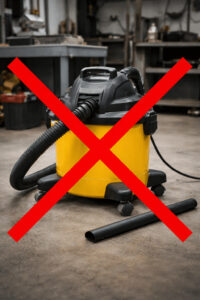
The fix: Switch to NFPA-compliant, explosion-proof or intrinsically safe vacuum systems designed specifically for combustible dust. Household shop vacs lack grounding, spark-resistant components, and proper filtration, making them ignition sources in dust-rich environments. Use certified industrial vacuums rated for combustible dust. For frequent cleanup around machines, tie into your dust collection system a floorsweep(s) instead of portable vacs. This reduces reliance on any vacuum while capturing dust at the source.
Mistake #4: Treating the Hopper as Storage
What we see: Dust accumulates in hoppers because someone forgot to empty the bin or worse, someone decided the hopper could double as temporary storage.
Why it’s a problem: A dust collector’s hopper is not designed to store dust. It’s a funnel nothing more. When dust sits in the hopper, it creates multiple risks:
- Fire and explosion hazard: Accumulated dust in the hopper increases the amount of combustible material in the system. One spark, and you have a explosion.
- Clogging: Dust buildup prevents new dust from moving through, which affects differential pressure and cleaning efficiency.
- Performance loss: When dust recirculates, it redeposits on filters, making the system work harder.
The Hayes Lemmerz explosion in Huntington, Indiana, serves as a tragic reminder of what happens when combustible dust isn’t managed properly. Don’t let your facility become a case study.
The fix: Empty hoppers/dumpsters regularly daily for high-volume operations, weekly for lighter loads. Use self-dumping hoppers that make disposal easy and safe. And if you keep push off the emptying of the collector the more chance you will keep pushing off the task and possibly forgetting entirely about the maintenance.
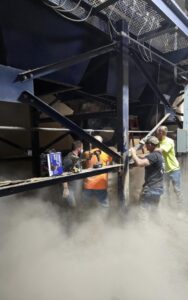
Don’t use the hoppers like a storage area. The company waited far too long to have their collector cleaned. The hoppers were clogged and plums of dust filled the factory.
Made One of These Mistakes? You’re Not Alone.
At Collectors & Filters in Whitestown, we’ve helped Indiana manufacturers fix all of them. Whether you’re running a one-person custom shop in Nashville, Indiana, or a 300-employee furniture plant in Jasper, we’ll walk through your facility, measure what’s actually happening, and tell you what’s working and what’s not.
Mistake #5: Assuming “Fan Running = System Working”
What we see: A facility manager walks past a running dust collector, hears the fan, and assumes everything is fine. The system sounds like it’s working, so it must be working, right? Not necessarily.
Why it’s a problem: A running fan only tells you that electricity is reaching the motor. It doesn’t tell you whether air is actually moving at the right velocity to capture dust at the source. We’ve walked into dozens of Indiana facilities where the fan was running loudly, but when we measured airflow at the hoods, it was quite lower then the designed specifications.
Dust was escaping into the shop. Employees were breathing it. And no one knew because no one had checked. When things progress slowly it is hard to notice.
A running fan only tells you that electricity is reaching the motor. It doesn’t tell you whether air is actually moving to capture dust.
What actually matters:
- Differential pressure across your filters tells you if they’re loading properly or if something is wrong
- Airflow velocity at each hood tells you if capture is effective
- Static pressure throughout the system tells you if ductwork is sized correctly or if there are blockages
The fix: Don’t trust your ears. Trust your instruments and the experts. Every dust collection system should have:
- Permanent magnehelic gauges or digital monitors showing differential pressure
- Regular airflow checks at hoods (at least quarterly) using a velometer
- A relationship with a trusted service provider who can help you interpret what the numbers mean
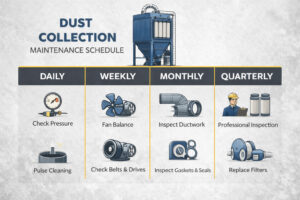
How to Build a Maintenance Schedule That Actually Works
Preventive maintenance doesn’t have to be complicated. Here’s a simple schedule based on industry best practices:
| Frequency | Tasks |
|---|---|
| Daily | Check differential pressure; verify pulse cleaning operation; empty hoppers if full |
| Weekly | Inspect fans for vibration and buildup; check drive belts; verify air pressure |
| Monthly | Inspect ductwork for leaks or blockages; check seals and gaskets; test airflow at hoods |
| Quarterly | Professional system assessment; replace filters if pressure drop exceeds limits |
| Annually | Full system inspection; review NFPA compliance; plan for future needs |
At Collectors & Filters, we help Indiana manufacturers verify that their systems are actually working properly not just running. Give us a call and we’ll walk you through what to measure and how.
SOLUTIONS
Dust Collectors
Baghouse Dust Collector
Mist Collector
Cyclone Dust Collectors
Cartridge Dust Collector
Weld Fume Extraction
Downdraft Tables
- Silo-Bin Vents
- Cyclone Hoppers and Stands
SHARE
EQUIPMENT
Filters
Dust Collector Working?
A running fan doesn’t mean your system is capturing dust. The fan may be loud but the air is still dirty.
✓ System assessments and airflow checks
✓ Ductwork sizing and static pressure analysis
✓ Indiana-based application support
Common Questions About Dust Collection System Mistakes and Maintenance
How do I know if my dust collection filters need to be replaced or just cleaned?
Watch your differential pressure gauge. If pulse cleaning knocks the pressure back down close to baseline, the filters still have life in them. If differential pressure stays elevated after a full cleaning cycle and keeps climbing between cycles, the filter media is blinded and cleaning is no longer effective. At that point replacement filters are the only fix. Running blinded filters past their service life drops airflow, reduces capture velocity at every hood, and puts the system fan under continuous stress. The filter replacement cost is minor compared to the labor and downtime from a system that cannot perform. See our full range of dust collector cartridges and filter bags.
My dust collector was working fine until we added a new machine. Now it seems weaker everywhere. What happened?
Adding a machine without recalculating static pressure and airflow requirements is one of the most common mistakes we see in Indiana facilities. Every new branch and hood adds resistance and draws CFM from the system. The fan was sized for the original load. Adding to it without upsizing the fan or rebalancing the ductwork reduces airflow at every existing pickup point simultaneously. The system sounds normal because the fan is still running, but capture velocity at every hood has dropped. This is also a compliance issue because NFPA 660 requires adequate capture velocity at every dust generation point. Our complete guide to industrial dust collection systems covers proper sizing in detail.
How do I know what is actually causing my system to underperform before I spend money replacing anything?
Measure before you spend. Check differential pressure across the filters first, blinded filters are the most common and cheapest fix. Then check for ductwork leaks, which rob the system of static pressure without any visible sign. Verify all blast gates are fully open on active machines. Check the fan motor amp draw against nameplate, a motor pulling less than rated amperage indicates airflow restriction somewhere in the system. Only after ruling out those causes does it make sense to consider equipment replacement. See our guide on how to size a dust collector for a better understanding of how airflow and static pressure interact. We can walk through this assessment with you over the phone in most cases.
We added compressed air to trigger the pulse cleaning. Now our system seems worse. What went wrong?
Pulse-jet cleaning requires clean dry compressed air at 90 to 100 PSI with adequate volume. If your compressed air supply is undersized, wet, oily, or shared with production equipment that draws it down, the pulse cleaning will be weak or inconsistent. Filters that are not fully cleaned with each pulse load progressively faster. Check your compressed air pressure at the collector inlet under load, not at the compressor. Also verify the pulse timer and solenoid valves are cycling correctly. A pulse cleaning system that fires too infrequently or with insufficient pressure is almost as bad as no pulse cleaning at all. If you are considering switching to a shaker-cleaned system that requires no compressed air, AGET Manufacturing builds exactly that with over 600 models from 1/3 to 75 HP.
How do I know if our facility needs explosion protection on our dust collector?
If your process generates wood dust, metal dust, grain, flour, plastics, or any organic particulate, your dust is likely combustible and NFPA 660 applies to your facility. The standard became effective December 6, 2024 and eliminated grandfathering of legacy systems. You need a Dust Hazard Analysis to determine exactly what protection is required for your specific dust and system configuration. We pair dust collectors with FLAMEX spark detection and abort gates and isolation valves for complete NFPA-compliant protection packages. Running without explosion protection on a combustible dust application is not just a compliance gap, it is a life safety issue.
What is the most expensive dust collection mistake Indiana facilities make?
Buying the wrong size system from the start. An undersized collector eats filters, burns up fan motors, and fails to protect workers. An oversized collector on undersized ductwork drops transport velocity and deposits combustible dust inside the duct system, creating a fire hazard that builds every shift. Neither problem is obvious until something breaks or an inspector arrives. The fix in both cases is expensive because it usually requires replacing either the collector, the fan, or the ductwork, sometimes all three. Want to know what a correctly sized replacement would cost? Use our dust collection cost estimator for a ballpark, or read our full 2026 Indiana dust collection cost guide for a detailed breakdown.
Do you service dust collection systems you did not install?
Yes. We assess, service, and upgrade dust collection systems regardless of who installed them or what brand they are. We represent AGET Manufacturing, ACT Dust Collectors, and Nordfab ductwork, which means we can source replacement components and upgrades across a wide range of system types. We measure actual system performance, verify compliance against current NFPA 660 and OSHA standards, and give you a direct assessment of whether the system can be corrected or needs replacement. We do not recommend replacement when correction is adequate. Contact us or call 317-910-1497. Most questions get answered the same day.